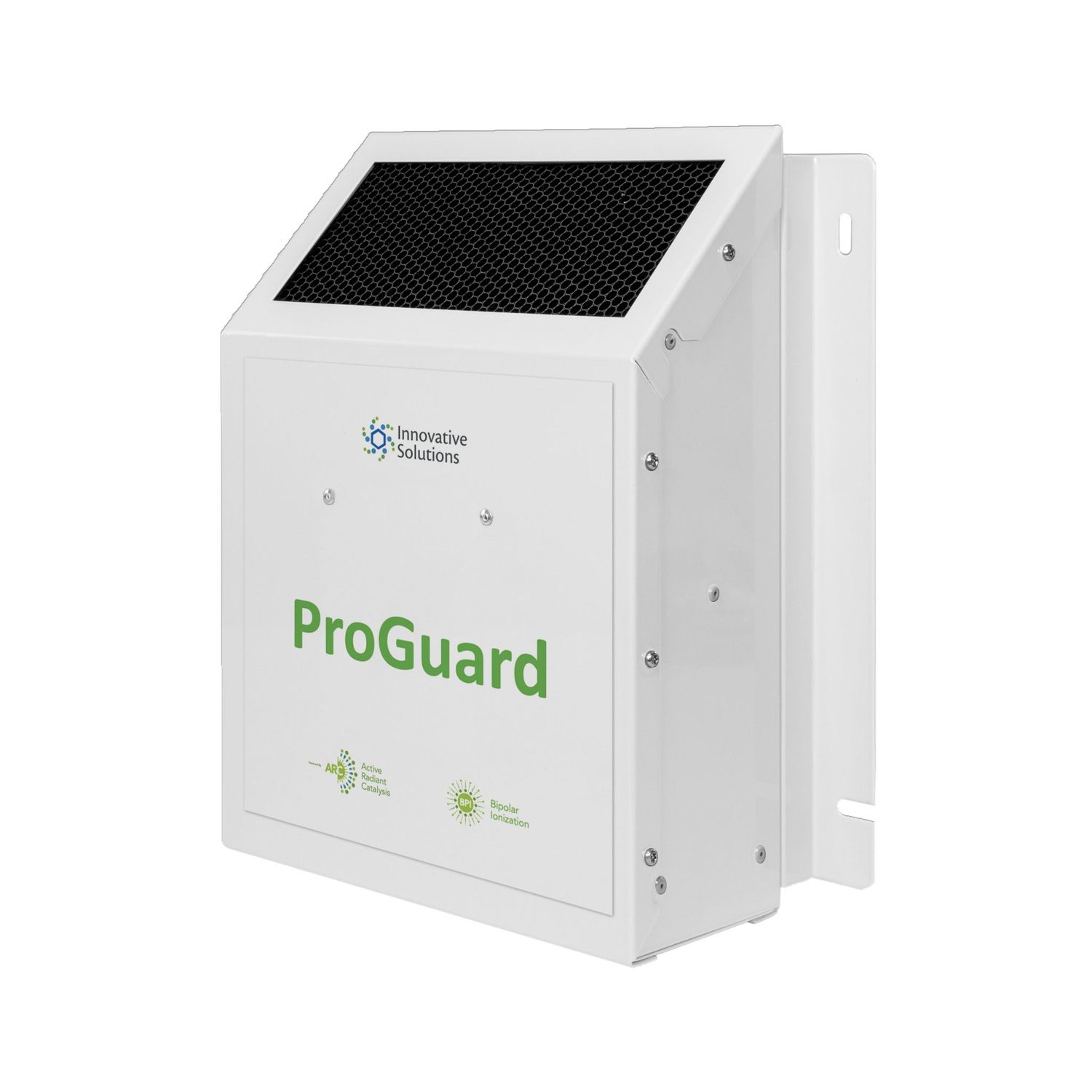
Defender DXB Mini with BPI
SKU Pguard
693.80 CHF
On backorder
Price per unit: 750 CHF
Defender DXB Mini with BPI.
1
Defender DXB Mini with BPI
Product Details
Brand: ProGuard
ProGuard Defender DXB Mini with BPI
The ProGuard Defender DXB Mini with BPI is a professional air and surface sanitisation system designed for smaller indoor cultivation environments where continuous pathogen control and high levels of cleanliness are required.
The system combines photocatalytic oxidation (PCO) with bipolar ionisation (BPI) to continuously treat both the air and exposed surfaces within the cultivation environment.
The PCO process uses energy to activate a catalyst, converting moisture naturally present in the air into dry hydrogen peroxide and other sanitising elements that are distributed throughout the space.
BPI technology generates positively and negatively charged ions that help reduce mould, fungi, bacteria, viruses and other potentially harmful pathogens. The ionisation process also helps airborne particles combine into larger clusters, allowing them to fall out of the air more easily.
Unlike systems that treat only the air passing directly through the unit, ProGuard continuously distributes its sanitising effect throughout the cultivation environment.
The DXB Mini is designed for continuous 24/7 operation. For cultivation areas smaller than approximately 15 m², the manufacturer recommends using a plug-in timer instead of operating the unit continuously.
For optimum performance, the unit should be installed close to the air intake and away from the extraction point. It should be positioned at least approximately 1 m away from the fan to ensure effective distribution.
The unit can be mounted on a wall or suspended from the ceiling. It must be protected from water and should not be installed directly next to cultivation lighting.
Regular maintenance helps maintain effective operation. The air filters should generally be replaced every 3–4 months or according to environmental conditions, while the PCO BPI Kit should be replaced every 12 months.
Key Benefits
- Professional air and surface sanitisation system
- Designed for smaller cultivation environments
- Combines PCO and BPI technologies
- Photocatalytic oxidation technology
- Bipolar ionisation
- Treats both air and exposed surfaces
- Helps reduce mould and fungi
- Helps reduce bacteria and viruses
- Helps reduce airborne pathogens
- Helps remove airborne particles
- Designed for continuous 24/7 operation
- Wall or ceiling installation
- Compact construction
- Low power consumption
- Replaceable air filters
- Replaceable PCO BPI Kit
Technical Specifications
- Recommended coverage area: 23 m²
- Unit weight: 1.4 kg
- Dimensions: 26 × 23.5 × 7.6 cm
- Supply voltage: 100–240 V AC
- Input power: 15 W
- Operating voltage: 24 V DC
- Operating current: 0.77 A
- Operating power: 14–22 W
- Recommended minimum distance from fan: approx. 1 m
- Air filter replacement interval: approx. every 3–4 months or as required
- PCO BPI Kit replacement interval: every 12 months
- Warranty: 2 years
ProGuard Defender DXB Mini mit BPI
Der ProGuard Defender DXB Mini mit BPI ist ein professionelles System zur Luft- und Oberflächendesinfektion für kleinere Indoor-Kultivierungsumgebungen, in denen eine kontinuierliche Reduzierung von Krankheitserregern und ein hoher Hygienestandard erforderlich sind.
Das System kombiniert photokatalytische Oxidation (PCO) mit bipolarer Ionisation (BPI), um sowohl die Luft als auch exponierte Oberflächen innerhalb der Kultivierungsumgebung kontinuierlich zu behandeln.
Beim PCO-Verfahren wird mithilfe von Energie ein Katalysator aktiviert. Dabei wird die natürlich in der Luft vorhandene Feuchtigkeit in trockenes Wasserstoffperoxid und weitere desinfizierende Elemente umgewandelt, die im Raum verteilt werden.
Die BPI-Technologie erzeugt positiv und negativ geladene Ionen, die zur Reduzierung von Schimmel, Pilzen, Bakterien, Viren und weiteren potenziell schädlichen Krankheitserregern beitragen. Durch die Ionisation können sich ausserdem luftgetragene Partikel zu grösseren Einheiten verbinden und dadurch leichter aus der Luft absinken.
Im Gegensatz zu Systemen, die ausschliesslich die direkt durch das Gerät strömende Luft behandeln, verteilt ProGuard die desinfizierende Wirkung kontinuierlich innerhalb der Kultivierungsumgebung.
Der DXB Mini ist für einen kontinuierlichen 24/7-Betrieb ausgelegt. Bei Kultivierungsflächen unter ca. 15 m² empfiehlt der Hersteller die Verwendung einer Steckdosen-Zeitschaltuhr, anstatt das Gerät dauerhaft zu betreiben.
Für eine optimale Wirkung sollte das Gerät in der Nähe der Zuluft und entfernt von der Abluft installiert werden. Zum Ventilator sollte ein Abstand von mindestens ca. 1 m eingehalten werden, um eine gleichmässige Verteilung zu gewährleisten.
Das Gerät kann an einer Wand montiert oder von der Decke abgehängt werden. Es muss vor Wasser geschützt werden und sollte nicht unmittelbar neben der Beleuchtung installiert werden.
Eine regelmässige Wartung unterstützt die optimale Funktion. Die Luftfilter sollten in der Regel alle 3–4 Monate oder entsprechend den Umgebungsbedingungen ausgetauscht werden. Das PCO BPI Kit sollte alle 12 Monate ersetzt werden.
Wichtigste Vorteile
- Professionelles Luft- und Oberflächendesinfektionssystem
- Für kleinere Kultivierungsumgebungen entwickelt
- Kombination aus PCO- und BPI-Technologie
- Photokatalytische Oxidation
- Bipolare Ionisation
- Behandelt Luft und exponierte Oberflächen
- Unterstützt die Reduzierung von Schimmel und Pilzen
- Unterstützt die Reduzierung von Bakterien und Viren
- Unterstützt die Reduzierung luftgetragener Krankheitserreger
- Unterstützt die Entfernung luftgetragener Partikel
- Für kontinuierlichen 24/7-Betrieb entwickelt
- Wand- oder Deckenmontage
- Kompakte Konstruktion
- Niedriger Stromverbrauch
- Austauschbare Luftfilter
- Austauschbares PCO BPI Kit
- 2 Jahre Garantie
Technische Daten
- Empfohlene Abdeckungsfläche: 23 m²
- Gerätegewicht: 1,4 kg
- Abmessungen: 26 × 23,5 × 7,6 cm
- Versorgungsspannung: 100–240 V AC
- Eingangsleistung: 15 W
- Betriebsspannung: 24 V DC
- Betriebsstrom: 0,77 A
- Betriebsleistung: 14–22 W
- Empfohlener Mindestabstand zum Ventilator: ca. 1 m
- Wechselintervall Luftfilter: ca. alle 3–4 Monate oder nach Bedarf
- Wechselintervall PCO BPI Kit: alle 12 Monate
Display prices in:CHF